TL;DR
Most nations rely on AI systems they don’t truly control. Data may sit locally, but foreign laws, models, infrastructure, and supply chains still determine who holds real power over national intelligence. Sovereign AI means reclaiming this control across governance, talent, models, data, compute, and hardware, through a unified framework that ensures legal independence, operational autonomy, and long-term economic resilience.
AI now underpins the systems nations rely on: healthcare, borders, finance, energy. Yet much of this intelligence still runs on infrastructure, models, and platforms governed by foreign jurisdictions. The technology is local, the authority behind it is not.
This is the core of Sovereign AI:
Sovereignty is not about where AI runs, but who ultimately controls the intelligence your country depends on.
The Illusion of Control: Data Residency is Not Sovereignty
Governments often pursue “digital sovereignty” through sovereign clouds or in-country hosting. But these measures only answer one question:
Where does data sit?
Not the crucial one:
Whose laws and systems govern it?
Data can be stored nationally yet remain subject to foreign legal reach.
Laws like the U.S. CLOUD Act make this explicit.
Local storage is not local control, dependency is the real risk.
Why Sovereign AI Is Now a National Imperative
Three forces are pushing Sovereign AI from an innovation conversation to a strategic requirement:
Rising Demand: Leaders want autonomy to manage geopolitical risk, regulation, and public trust.
Concentrated Risk: Control of compute and data defines who captures economic value and who becomes dependent.
Ecosystem Reality: Sovereign AI isn’t defensive, it builds capability, industries, and geopolitical leverage.
Three Myths About Sovereign AI
Myth #1: "Data Residency Equals Sovereignty"
False.
As noted earlier, your data can sit in-country while foreign laws like the CLOUD Act give foreign governments a backdoor key. You own the house, but they have the master key.
True control comes from jurisdiction, not geography.
Myth #2: "We Can't Afford Sovereign AI"
The truth?
You can’t afford the alternative. The cost of a single regulatory breach, one intellectual property theft, or being locked out of critical AI systems during a crisis, these aren’t expenses. They’re existential threats.
The Total Cost of Sovereignty (TCS) framework proves that investing in autonomy is far cheaper than the long-term risk of dependency. (See the full calculation in the Appendix)
Myth #3: "Sovereignty Slows Innovation"
Actually, dependency does.
When you’re tied to another nation’s technology stack, you innovate at their pace, on their terms, for their benefit. Comprehensive Autonomy unleashes innovation by allowing you to build AI that is tailored to your specific economic and societal needs.
The Architecture of Autonomy: A Layered Approach
Achieving autonomy requires mastering six interdependent domains. Most organizations focus on one or two, creating critical vulnerabilities across the stack.
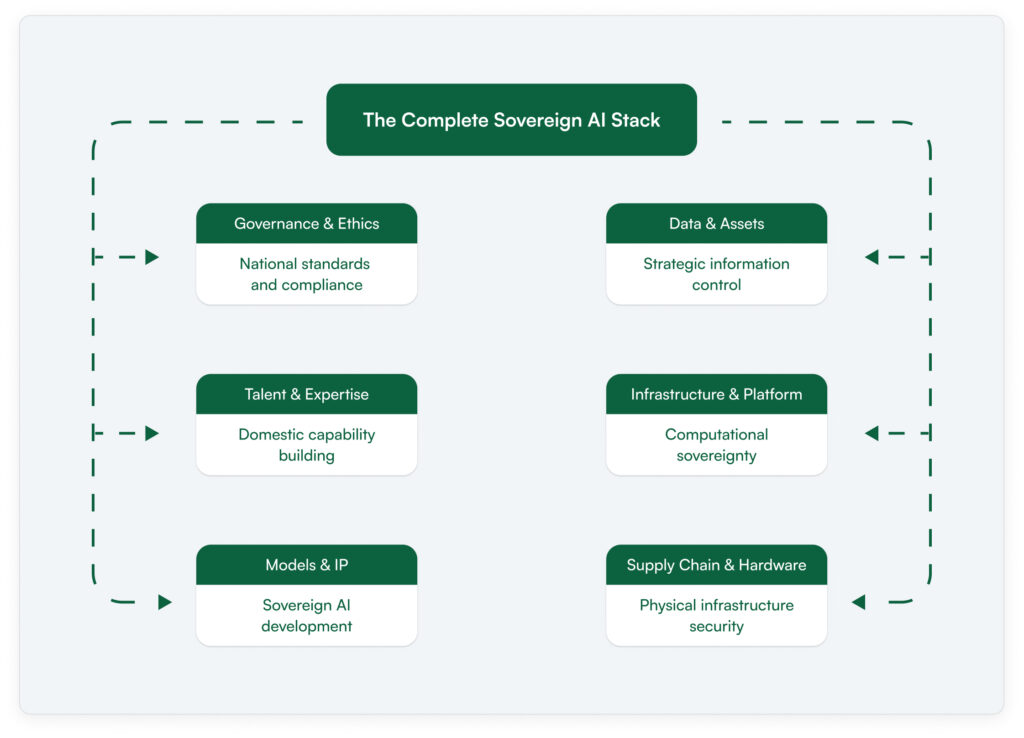
1. Governance & Ethics: The National AI Constitution
Defines what AI may do, how it is audited, and how citizens are protected.
If you cannot inspect or govern AI, you do not control it.
2. Talent & Expertise: The Engine of National Capability
Domestic expertise in data science, engineering, cybersecurity, MLOps, ethics, and policy is essential.
When talent is outsourced, capability is outsourced.
3. Models & IP: The Intelligence Layer
Foreign foundational models embed foreign priorities.
Sovereignty requires controlling model weights, context, and AI IP.
4. Data & Assets: The Strategic Fuel of Your AI Economy
Sovereign data means governed exclusively by national laws, not just stored locally.
5. Infrastructure & Platform: The Computational Heartbeat
Compute must be unified, vendor-agnostic, and legally sovereign.
If a foreign vendor can throttle, inspect, or suspend your infrastructure, you do not have sovereignty.
6. Supply Chain & Hardware: The Fragile Foundation
Without secure access to GPUs, networking, and secure hardware, national AI can freeze overnight.
From Layers to Strategy: Moving From WHAT to HOW
These six domains define what must be sovereign. But knowing what to sovereignize is only half the challenge. Nations also need a strategic operating model to execute sovereignty across all six layers. This is where the 3C Framework provides the principles that unify the entire sovereignty stack into a coherent, governable system.
The 3C Framework: Turning Sovereignty into an Operating System
The six domains define what must be sovereign.
The 3C Framework: Compliance, Control, and Capital Efficiency, defines how sovereignty is operationalized across every domain.
Rather than addressing sovereignty as a collection of isolated fixes, the 3Cs provide a unifying operating philosophy:
Compliance → Who governs your intelligence?
Control → Who operates it?
Capital Efficiency → What is the full, long-term cost and value of your AI decisions?
This framework transforms sovereignty from a checklist into a coherent, governable system.
1. Compliance: From Data Location to Legal Independence
Ensures AI is governed solely by domestic law and immune to foreign legal reach.
2. Control: From Vendor Fragmentation to Unified Autonomy
Compute, orchestration, AIOps, data governance, and models must operate as a unified sovereign platform.
3. Capital Efficiency: From Procurement Cost to Total Economic Impact
Non-sovereign clouds hide massive Sovereignty Debt: regulatory risk, lock-in, egress, crisis-time disruption, IP leakage.
Sovereign platforms eliminate these costs and create long-term value.
To understand how sovereignty shifts the economics of AI from cost to value, including full TCS and RAROI calculations, see the Appendix at the end of this guide.
The Sovereign AI Battlefield: 6 Strategic Nightmares and Your 3C Defense
The six layers define what must be sovereign.
The 3C Framework defines how sovereignty is enforced.
But strategy becomes real only when you understand the failures these layers are designed to prevent.
Every sovereignty layer has a corresponding existential threat.
And for every threat, the 3Cs form the defense system that keeps nations operationally secure, legally protected, and economically resilient.
This is where the frameworks converge:
the 6 Layers identify the vulnerabilities,
and the 3Cs provide the operating principles to neutralize them.
The table below maps each national-scale failure mode (“sovereign nightmare”) to the vulnerable layer it targets, and the 3C defense that prevents it.
| The Sovereign Nightmare | Vulnerable Layer | The 3C Battle Plan |
|---|---|---|
| 1. The Digital Colonization of Your Economy Your industries become permanently dependent on foreign AI models, forever paying tribute in data, IP, and licensing fees. | Models & IP | COMPLIANCE: Shield AI IP from export controls. CONTROL: Own the full model lifecycle. CAPITAL: Convert recurring licensing fees into owned sovereign AI capability. |
| 2. The International Data Scandal A foreign government serves a legal order to access your sensitive data, destroying citizen trust and violating national laws. | Data & Assets | COMPLIANCE: Architect for jurisdictional immunity. CONTROL: Prevent unauthorized data exfiltration. CAPITAL: Mitigate billions in fines and reputational damage. |
| 3. The Strategic Shutdown During a crisis, a foreign provider suspends your access to critical AI infrastructure, halting public services and security operations. | Infrastructure & Platform | COMPLIANCE: Ensure sovereign legal status for infrastructure. CONTROL: Operate a unified, vendor-agnostic platform. CAPITAL: Eliminate the cost of operational disruption. |
| 4. The Brain Drain Death Spiral Your brightest AI talent emigrates, leaving no domestic capability to build or maintain your AI stack. | Talent & Expertise | COMPLIANCE: Protect national knowledge. CONTROL: Build sovereign centers of excellence. CAPITAL: Convert consultant costs into domestic investment. |
| 5. The Unaccountable Algorithm An AI system makes a decision that violates your national ethics, but you cannot audit or explain it. | Governance & Ethics | COMPLIANCE: Enforce national ethical standards. CONTROL: Embed native auditing tools. CAPITAL: Transform compliance into an asset of trust. |
| 6. The Hardware Embargo Geopolitical tensions halt the supply of critical components, freezing your entire AI ambition. | Supply Chain & Hardware | COMPLIANCE: Mitigate risk through diversified sourcing. CONTROL: Maintain operational security over hardware. CAPITAL: Invest strategically in hardware reserves to avoid catastrophic service disruption. |
Conclusion: The Path to Strategic Independence
Sovereign AI is not an upgrade. It is not a product category.
It is a national strategy, reshaping how countries build, govern, and benefit from intelligence.
Nations that secure Comprehensive Autonomy will:
maintain operational continuity under pressure
unlock innovation tailored to their people
capture more economic value
build new industries around local capability
negotiate globally from a position of technological strength
Nations that do not will be governed by the systems they depend on.
The question is no longer:
“Should we pursue Sovereign AI?”
It is:
“How quickly can we achieve it?”
Appendix: Calculating the Total Cost of Sovereignty (TCS) and Risk-Adjusted ROI (RAROI)
Most national AI programs dramatically underestimate the real cost of foreign-dependent AI because they only look at direct expenses (compute, storage, licenses). This appendix explains in simple, explicit terms, how to calculate the Total Cost of Sovereignty (TCS) and the Risk-Adjusted Return on Investment (RAROI).
The goal is to help you see the difference between the sticker price and the true economic impact of their AI decisions.
1. Total Cost of Sovereignty (TCS): The Real Cost Model
TCS = Direct Costs + Sovereignty Debt
Where:
Direct Costs = what you pay directly (compute, storage, licenses, ops)
Sovereignty Debt = hidden risks and penalties caused by dependency on foreign-controlled infrastructure and models
This formula exposes the true cost of non-sovereign AI.
Example: A National AI Project Over 3 Years
Below is a realistic scenario showing how a “cheap” cloud solution becomes extremely expensive once dependency risks are priced in.
A. Direct Costs (Non-Sovereign Cloud)
| Cost Component | Amount |
|---|---|
| Compute, storage, licenses, operations | $6M |
B. Sovereignty Debt (Probability-Weighted Risk Costs)
These are the hidden, often ignored costs that arise because the nation is dependent on a foreign-controlled AI stack.
| Risk Category | Probability | Impact | Cost (Weighted) |
|---|---|---|---|
| Regulatory fines (e.g., data access violations) | 15% | $5M | $2.25M |
| IP leakage (foreign jurisdictions & shared training data) | 20% | $10M | $6M |
| Vendor lock-in premium | 90% | $1.5M | $4.05M |
| Crisis-time access denial (suspension, throttling) | 5% | $8M | $1.2M |
| Data egress / repatriation costs | 80% | $500k | $400k |
| Total Sovereignty Debt | $14.7M |
C. Total TCS (Non-Sovereign)
| Formula | Result |
|---|---|
| TCS = Direct Costs + Sovereignty Debt | $6M + $14.7M = $20.7M |
Key Insight:
A solution that appears to cost $6M actually costs $20.7M when risks are included.
2. Sovereign Platform TCS
A sovereign platform may have higher upfront costs, but it eliminates almost all Sovereignty Debt because:
no foreign legal reach
no foreign-controlled APIs
no vendor lock-in
no repatriation or egress exposure
no geopolitical disruption dependence
Sovereign TCS Example
| Component | Amount |
|---|---|
| Direct costs (sovereign infrastructure + operations) | $8M |
| Sovereignty Debt | ≈ 0 |
| Total TCS (Sovereign) | $8M |
Result:
The “expensive” option is actually 2.5× cheaper when the true costs are counted.
3. Strategic Optionality: Extra Value That Only Sovereign AI Unlocks
This is value that foreign-dependent systems can never provide:
| Optionality Benefit | Description |
|---|---|
| Regulated Market Access | Deploy AI in health, finance, justice, and government without legal exposure. |
| Domestic Economic Value | National IP creation, local jobs, data localization, national compute ecosystem. |
| Diplomatic Leverage | Strategic independence as a geopolitical asset. |
These benefits are not included in the TCS formula, but they significantly increase long-term ROI.
4. Risk-Adjusted ROI (RAROI): The Executive Reality Check
Traditional ROI compares benefits against direct costs only.
RAROI compares benefits against the true cost (TCS) and adjusts for risk exposure.
This provides a realistic view of profitability.
Example: National Healthcare AI Diagnostics Program
Projected benefits: $15M
A. Non-Sovereign Approach (Foreign Cloud)
Apparent ROI (Misleading)
| Formula: (Net Profit ÷ Cost of Investment) × 100 | Result |
|---|---|
| ((15M – 6M) ÷ 6M) × 100 | 150% |
Looks amazing, but it ignores Sovereignty Debt.
Reality With RAROI
| Component | Amount | What This Means |
|---|---|---|
| Risk-Adjusted Benefits | $11.25M | The project originally promised $15M in benefits, but because it depends on foreign APIs and foreign legal jurisdictions, we apply a 25% risk discount. This means only 75% of the expected value can realistically be achieved. |
| Total TCS (True Cost) | $20.7M | The real cost of the non-sovereign approach: $6M direct cloud costs + $14.7M in sovereignty debt (regulatory risk, lock-in, IP leakage, crisis access, repatriation). |
| RAROI | ((11.25M – 20.7M) ÷ 20.7M) × 100 = –46% | After adjusting benefits for risk and using the true cost instead of the cloud invoice, the project actually loses value. The real return is –46%, meaning the project destroys value instead of creating it. |
Bottom Line:
The project goes from “highly profitable” to an actual strategic loss.
B. Sovereign Approach
| Component | Amount | What This Means |
|---|---|---|
| Risk-Adjusted Benefits | $15M+ | Because the sovereign stack is fully under national control (no foreign APIs, no legal exposure, no shutdown risk), we apply no discount. In fact, benefits often increase due to Optionality (regulated market access, domestic IP value, long-term independence). |
| Total TCS (True Cost) | $8M | The sovereign platform has a slightly higher direct cost, but eliminates the entire $14.7M sovereignty debt. The true cost is therefore just the direct sovereign investment. |
| RAROI | ((15M – 8M) ÷ 8M) × 100 = 87.5% | Using the full benefits and the true total cost, the sovereign approach delivers a strong positive return. RAROI shows the project creates value rather than destroying it. |