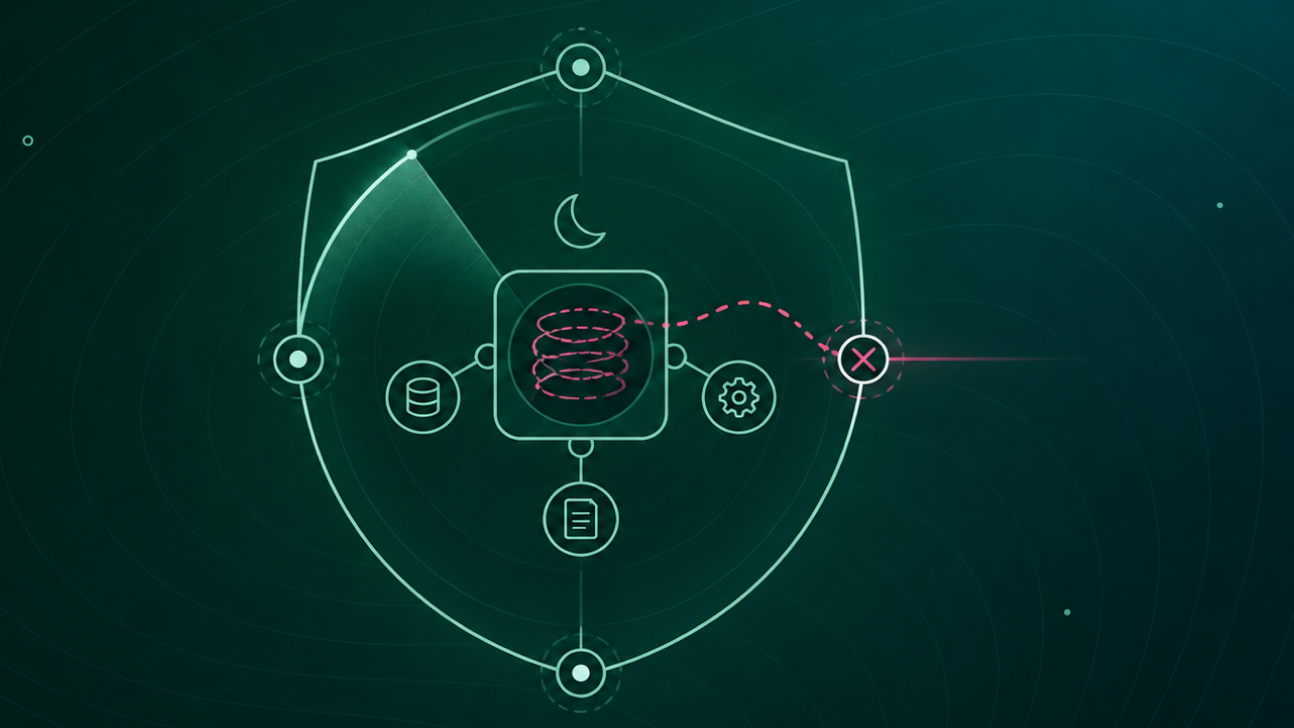
An employee asks the company’s internal AI assistant a routine HR question. The answer includes a colleague’s salary.
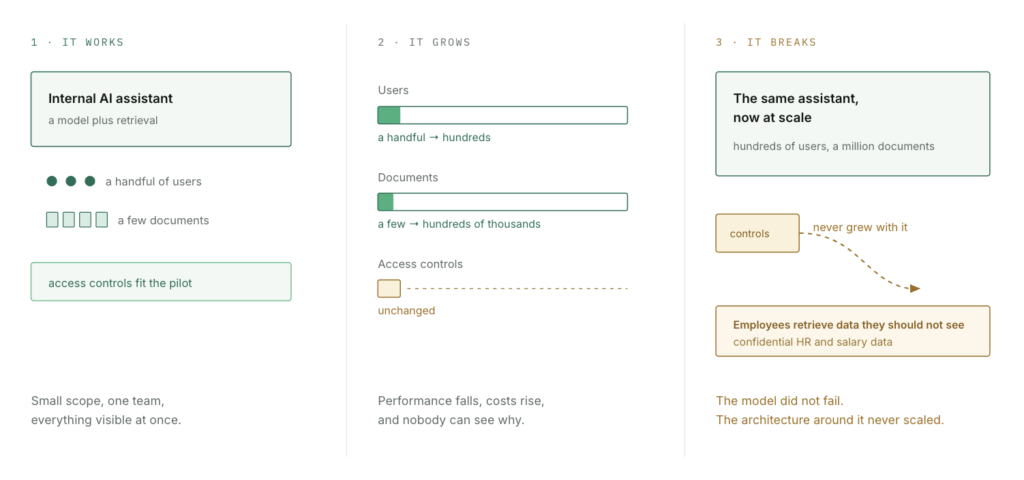
The employee was never authorized to see that information. The HR system knew that. The AI assistant did not.
When the HR documents were connected to the AI assistant, their original access permissions were not carried over. The file remained protected in HR, but its contents became retrievable through the AI.
No model was compromised. No server failed. Each component did what it was configured to do.
The access control did not carry across.
That is the problem with building enterprise AI as a collection of connected tools. The individual parts can work exactly as intended while the system as a whole fails.
Sovereign AI cannot depend on controls being stitched together after the fact. Identity, permissions, security, operations, and governance have to carry across the architecture.
It needs a fabric, not a stack.
What breaks when you assemble AI one piece at a time
Most enterprise AI environments are not designed as one system. They grow layer by layer.
A GPU cluster comes first. Then Kubernetes, model serving, notebooks, vector databases, applications, agent frameworks, monitoring, and security are added around it.
At small scale, that can work.
Then usage grows. A handful of users becomes hundreds. A few documents become hundreds of thousands. More models, workloads, agents, and teams compete for the same infrastructure.
That is when fragmentation becomes visible.
A performance issue in the application may originate in the model serving layer. A workload may wait for capacity while GPUs elsewhere sit idle. Identity and permissions may be enforced differently across systems. Monitoring may show what happened inside one component without showing what happened end to end.
What worked as a proof of concept becomes harder to operate, secure, and govern at scale, not because one tool stopped working, but because the architecture was never designed to work as one.
The cost of a disconnected AI stack
Governance drifts out of sync. Identity, access, and policy can be enforced differently across infrastructure, runtime, AI operations, and applications. A user may be authorized in one layer and restricted in another, with no consistent control running end to end.
Operations fragment. A spike in GPU usage may be visible at the infrastructure layer without showing which workload caused it, who owns it, or what happened further up the system. Troubleshooting becomes a cross-team exercise instead of an end-to-end view.
Investment takes longer to become value. Capacity can sit idle while another team waits for resources. Similar capabilities are deployed more than once, and engineering time shifts from launching AI use cases to maintaining the integrations between them.
Security becomes an add-on. Model scanning, red teaming, guardrails, approval workflows, and audit controls are harder to apply consistently when they are introduced separately at different points in the lifecycle. In regulated environments, those gaps create rework, governance risk, and slower deployment.
Vendor lock-in limits control. When infrastructure, orchestration, applications, and security depend tightly on one vendor’s architecture, changing a model, accelerator, or deployment environment can become a major integration effort.
These are not simply problems within individual tools. They emerge between them. Solving them consistently requires an architecture where infrastructure, runtime, AI operations, applications, and security are designed to work as one system.
What is a Sovereign AI Fabric
A Sovereign AI Fabric is an architecture that connects infrastructure, runtime, AI operations, applications, and security so they can operate as one system.
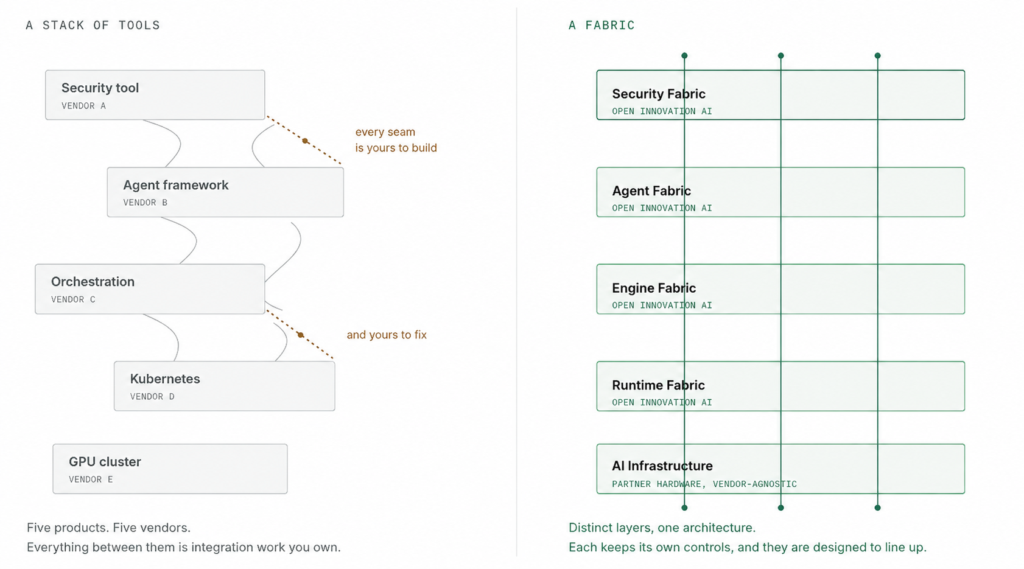
In a conventional AI stack, these layers are often selected and integrated separately. Each may work well on its own, but the organization is responsible for connecting identity, policy, security, operations, and visibility across them.
A fabric is designed around those connections. Each layer has a distinct role, while controls and context carry across the architecture instead of stopping at the boundary of one system and being rebuilt in the next.
The result is not simply fewer tools or dashboards. It is greater control over how AI runs end to end: where workloads execute, who and what can access them, how resources are managed, what agents can do, and how activity is governed and observed.
For governments and regulated enterprises, that distinction is fundamental. Sovereign AI is not only about where data resides. It is about maintaining control over how the entire AI system operates.
The layers of the Sovereign AI Fabric
The Sovereign AI Fabric brings together AI Infrastructure and four connected Fabrics: Runtime, Engine, Agent, and Security. Each has a distinct role, but all are designed to operate as one architecture.
AI Infrastructure provides the compute, storage, networking, and accelerators AI runs on, across on-premises, sovereign cloud, hybrid, and air-gapped environments, without locking the organization into a single hardware vendor.
Runtime Fabric provides the hardened Kubernetes environment AI workloads run in, with consistent isolation, scheduling, storage, lifecycle management, and policy enforcement.
Engine Fabric is the control plane for AI operations, orchestrating compute across clusters and tenants while supporting development, training, fine-tuning, inference, evaluation, and monitoring.
Agent Fabric is where AI applications and agents are built and operated, sharing enterprise knowledge, context, tools, identity, permissions, orchestration, and observability instead of rebuilding them for every use case.
Security Fabric applies security and governance across the AI lifecycle, from model scanning and red teaming to runtime guardrails, policy enforcement, behavioral monitoring, and audit.
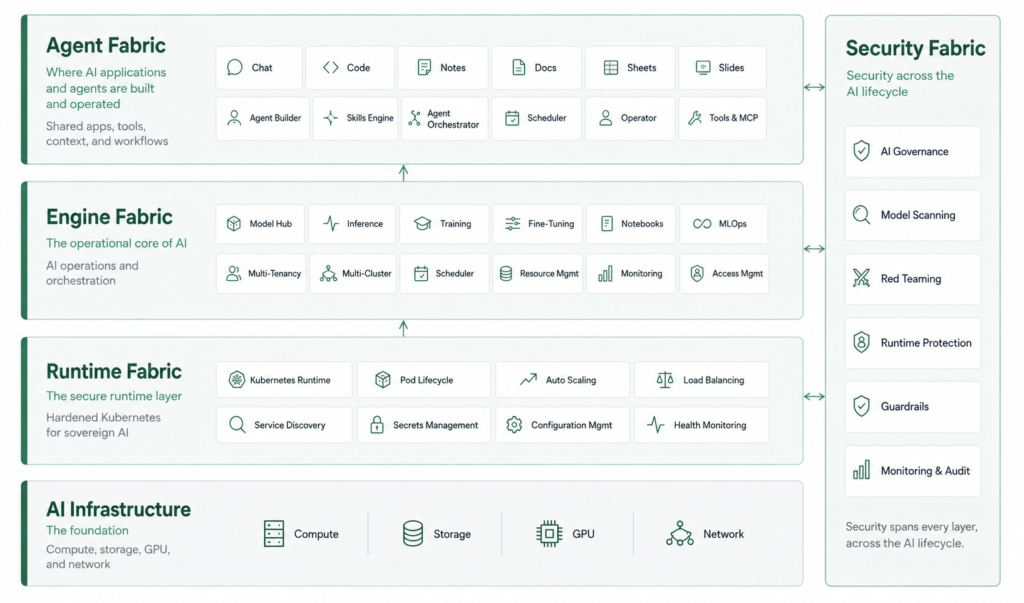
The names now describe the architecture
If the layers are designed to work as one system, the names should reflect that.
Our previous product names described individual capabilities. The Fabric names describe how those capabilities fit together as one architecture.
Open Innovation Cluster Manager is now Engine Fabric. OIK8 is now Runtime Fabric. OI AI Security is now Security Fabric. OI Apps is now Agent Fabric encompassing OI Chat, OI Code, OI Agents, and more. AI Infrastructure forms the foundation beneath them.
The products remain familiar. The names now describe the architecture, not just its parts.
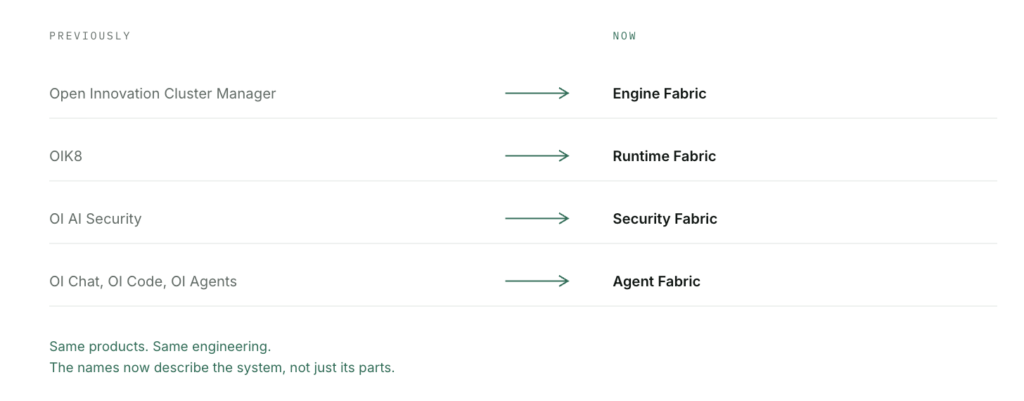
To conclude
Sovereign AI is not control over a model, a cluster, or a data center. It is control over the entire system.
The layers have to work together. Controls cannot disappear at the boundaries between them. And consequential actions must remain visible, governed, and under the organization’s authority.
That is the difference between owning AI components and truly owning your AI.
A stack can run AI. A Fabric makes it sovereign.
If you are mapping out sovereign AI for your organization, we are happy to walk you through it. Let’s talk.

Intissar El mezroui
Product Marketing Manager