Here is an uncomfortable truth for anyone budgeting an AI program in 2026: the model you pick may be the least important decision you make.
Consider a single data point. Vercel took one of its production agents, removed roughly eighty percent of its tools, and watched success rates climb from eighty percent to one hundred percent. Token consumption dropped by more than half. Latency fell from 724 seconds to 141 seconds. The model never changed. Only the scaffolding around it did.
That scaffolding now has a name, and learning to think about it clearly is one of the highest-leverage things a technology leader can do this year. It is called the agent harness.
What is an agent harness?
An agent harness is the software infrastructure that wraps a large language model and turns it from something that answers questions into something that gets work done. If the model is the brain that reasons and decides, the harness is everything around it that lets those decisions become actions in the real world.
In practice, a harness is made up of a handful of components working together: the orchestration loop that repeatedly calls the model, parses its output, runs any tool calls, feeds the results back, and decides when to stop; the tools and function calls that expose capabilities; context management that assembles and compacts what the model sees; state and memory that persist across turns; and the guardrails that enforce permissions, policy, and monitoring.
The term itself was only formalized in early 2026, but the concept is older than the vocabulary. What changed is that the industry finally agreed the layer deserved a name, because it turned out to be where most of the hard engineering, and most of the performance, actually lives.
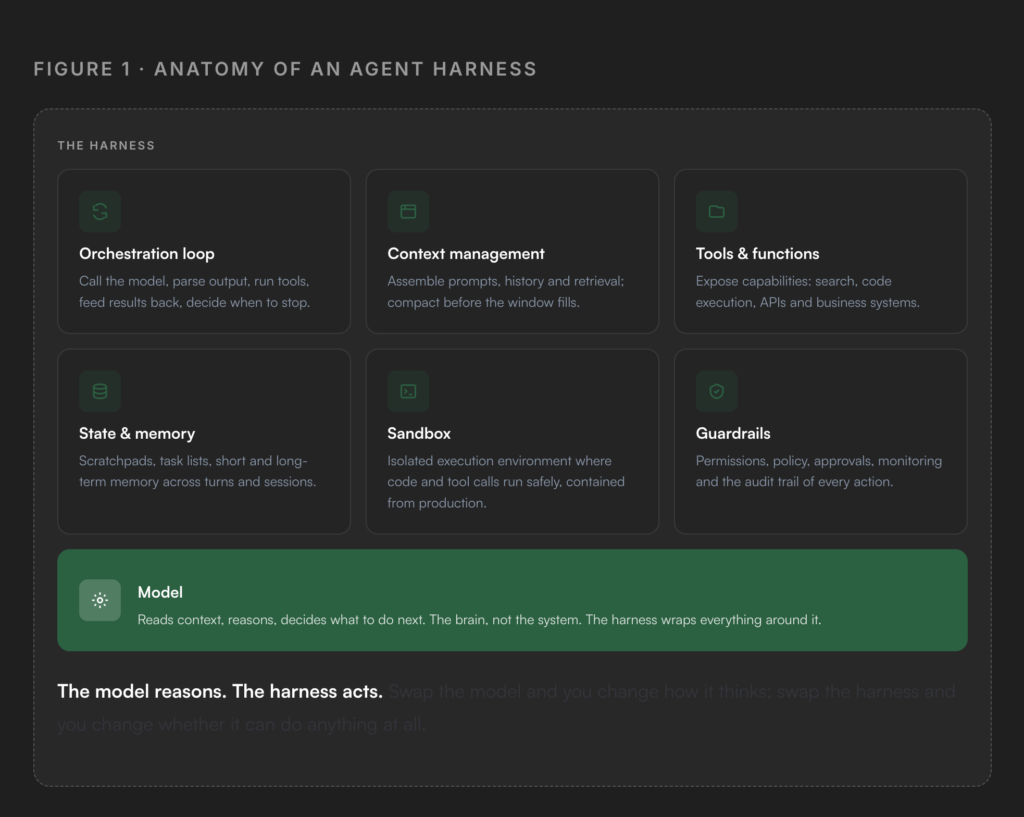
A useful way to hold the distinction: the model reasons, the harness acts. Swap the model and you change how well the agent thinks. Swap the harness and you change whether the agent can do anything at all.
The evidence: same model, wildly different results
If the harness were a commodity, changing it would not move the needle much. The benchmarks say otherwise, and the numbers are hard to ignore.
LangChain took a coding agent that sat near the bottom of Terminal Bench 2.0, changed only the infrastructure wrapping the model, and jumped into the top five, moving from 52.8 percent to 66.5 percent. Princeton’s CORE-Bench found the same model scoring 42 percent under one scaffold and 78 percent under another. Harvey more than doubled the accuracy of its legal agents through harness optimization alone. Across the board, changing only the harness has been shown to move agents more than twenty ranking positions.
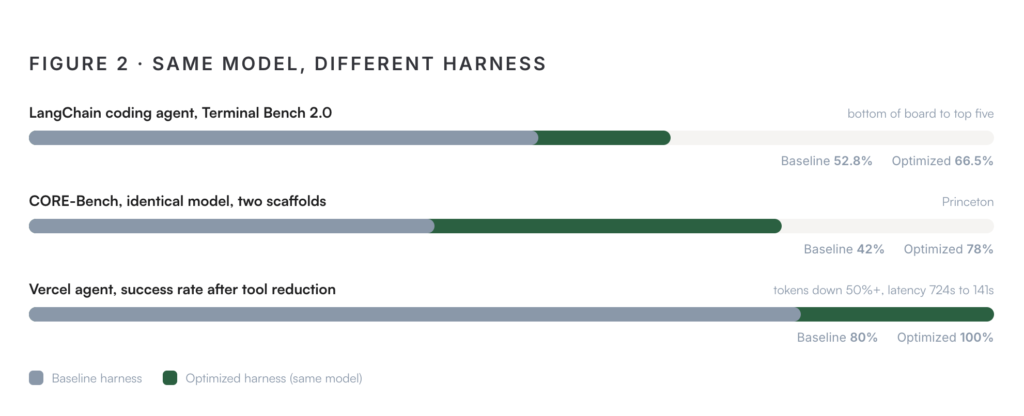
Read those results again. In each case the reasoning engine was held constant. The gains came entirely from the system around it: which tools were exposed, how context was managed, how failures were caught and retried, how the loop was structured.
The honest counterpoint
Thought leadership that only shows one side is marketing, so here is the other side. The evidence for harness supremacy is strong but not unanimous.
Scale AI’s SWE-Atlas found that for some model families, harness choice fell within the margin of error. Independent evaluations from METR have shown that polished, purpose-built harnesses do not consistently outperform a basic scaffold on every task. The harness matters enormously, but not infinitely, and not uniformly across every workload.
There is also a clear direction of travel. As models get more capable, the field is trending toward thinner harnesses, with more of the work handed back to the model itself. The harness is not going away, but its shape is changing, and betting your architecture on today’s scaffolding assumptions is its own kind of risk. The takeaway is not that the harness is everything. It is that the harness is a first-class engineering surface that most organizations still treat as an afterthought.
Why this matters more for regulated and sovereign enterprises
For compliance-sensitive, air-gapped, and government-adjacent deployments, the harness argument is not academic. It is decisive, for a simple reason: in these environments, the model is often the variable you cannot control.
Procurement rules, data residency requirements, and sovereignty mandates frequently fix which models you are allowed to run. What you do control, completely, is the harness. That reframes the buying conversation from “which model is smartest” to “which harness lets me operate an agent safely, provably, and reliably inside my constraints.” And the harness is exactly where the things regulators care about get implemented:
- Guardrails and permissions live in the harness, not the model. What an agent may touch, and under what approval, is a property of the surrounding system.
- Durable execution lives in the harness. Long-running work that survives a crash and resumes from a checkpoint is scaffolding, not intelligence.
- Audit and traceability live in the harness. The queryable record of what the agent did, and why, is produced by the loop and its instrumentation.
- Human-in-the-loop checkpoints live in the harness. Where a person must approve before an action executes is a design decision in the scaffolding.
An organization that obsesses over model selection while treating the harness as glue code is optimizing the one thing it may not control and neglecting the thing that determines whether the deployment is defensible.
What leaders should actually do
First, treat the harness as a product, not plumbing. Give it an owner, a roadmap, and an evaluation budget. The teams pulling ahead measure harness changes with the same rigor they once reserved for model choice.
Second, resist tool sprawl. The Vercel result is not an accident. More tools mean more context spent describing them, more ways for the model to get confused, and more surface area for failure. Fewer, sharper capabilities usually beat a bulging toolbox.
Third, build the harness for your constraints, not for a demo. If you operate in a regulated or sovereign context, the harness is where compliance is either designed in from the start or bolted on expensively later. Choose the first path.
The bottom line
The most capable model in the world, dropped into a weak harness, produces an unreliable agent. A capable model inside a well-engineered harness produces something an enterprise can actually stand behind. The model may be the brain, but the harness is the difference between a promising demo and a system you can deploy, defend, and depend on.
Agent Fabric is built for this reality: a harness engineered for regulated and sovereign environments, where the durable execution engine, the governance layer, and a fully queryable audit trail are part of the architecture rather than features added after the fact.
Sources and further reading
Databricks, “What is an AI Agent Harness?”
Daily Dose of DS (Avi Chawla), “The Anatomy of an Agent Harness”
MongoDB, “The Agent Harness: Why the LLM Is the Smallest Part of Your Agent System”
Hugging Face, “Harness, Scaffold, and the AI Agent Terms Worth Getting Right”

Muhammad Ahmad Afzal
Senior Product Manager