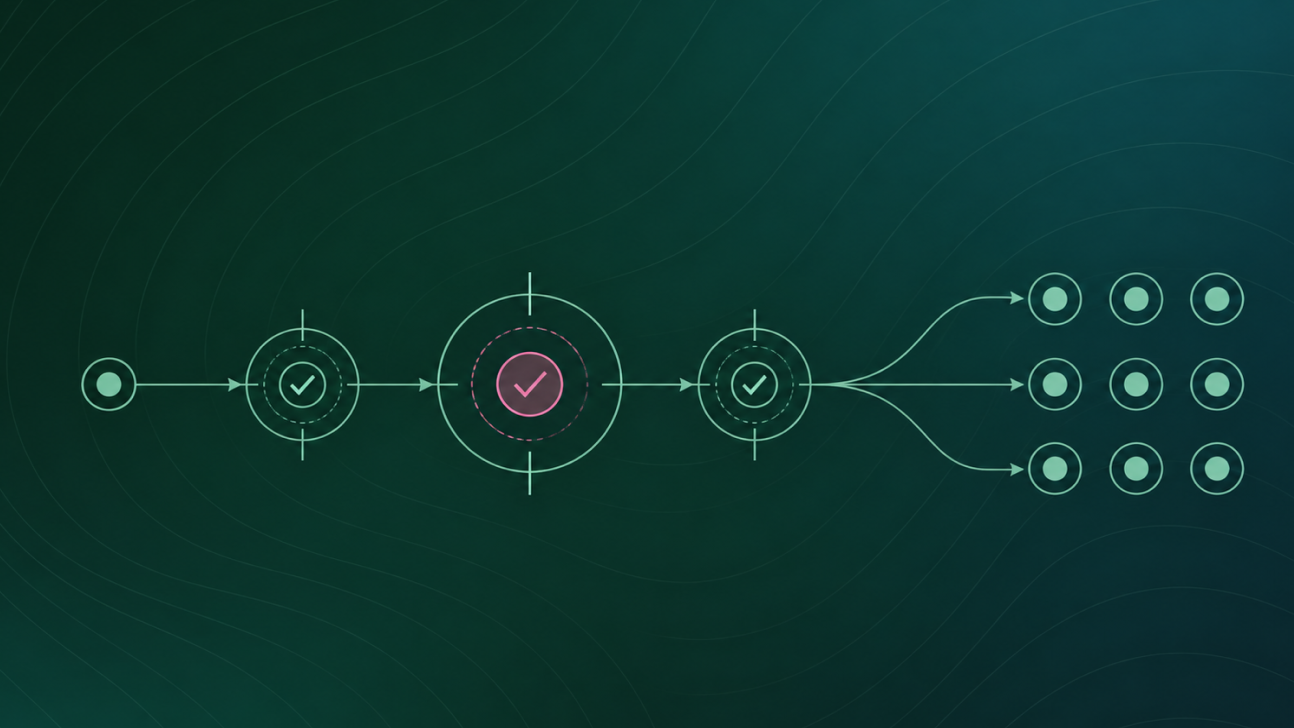
OI Parser, the document extraction engine powering document understanding across Agent Fabric, ranks 4th out of 92 methods on ParseBench, LlamaIndex’s public benchmark for document parsing, as of August 28, 2026. It is the top-ranked parser from any company other than the benchmark’s own creators, and on table extraction it scores 92.6, second in the world across the entire leaderboard.
It runs entirely inside the customer’s own infrastructure, with no data egress, which is the part that matters most for the regulated and sovereign customers we serve.
OI Parser is now also available as a standalone service at oi-parser.ai, in addition to being a core capability inside Agent Fabric.
What Is OI Parser?
OI Parser is a document extraction engine that turns unstructured enterprise documents into structured, machine-readable representations: layout, tables, charts, figures, semantic structure, and content faithfully grounded in the original page.
It supports the formats that account for the vast majority of enterprise document estates:
PDF (born-digital, scanned, and mixed)
DOCX (Microsoft Word)
XLSX (Microsoft Excel)
PPTX (Microsoft PowerPoint)
Images and scans (PNG, JPEG, TIFF)
Inside each format, it understands not just the text but the structure humans rely on: column layouts, multi-page tables, embedded charts, axis labels, plot legends, cell merges, slide hierarchies, and figure-caption relationships.
OI Parser ships in two ways:
As a built-in capability of Agent Fabric, used by the Knowledgebase, Assistant, and Agents modules for ingestion and retrieval grounding.
As a standalone document extraction service, deployable on-premises or in fully air-gapped environments and accessible through an API, for teams that want best-in-class extraction without adopting the full platform.
Why Document Extraction Is the Hidden Bottleneck in AI Systems
If you are building anything serious on top of an LLM, a retrieval pipeline, or an agentic workflow, the quality of your document extraction sets the ceiling on everything downstream.
A retrieval system can only retrieve what was indexed correctly. An agent can only reason over what was extracted accurately. A compliance review can only flag what was actually parsed from the page. And in every real enterprise document estate, the failure mode is the same: tables, charts, and figures.
Most extractors handle plain prose well. They fall apart on:
Tables that span pages, carry nested headers, or contain merged cells
Multi-axis charts and embedded plots
Mixed-layout pages with sidebars and footnotes
Scanned and photographed PDFs with non-trivial layout
Slide decks where the meaning sits in the visual hierarchy
Spreadsheets where cell formatting carries the meaning
That last one is worth dwelling on. A spreadsheet cell holding 0.845 formatted as a percentage means 84.5%. An extractor that reports the raw value has not lost a little precision, it has reported a different number. For a retrieval pipeline, that is the difference between a right and a wrong answer.
Traditional OCR flattens structure into a wall of text. The words survive; the meaning does not. A balance sheet with its rows and columns collapsed is not a smaller version of the truth, it is a different document. And an agent reasoning over mangled structure produces confident, wrong answers, which is worse than no agent at all: it spends the customer’s trust budget on output they cannot verify.
That gap matters because in regulated industries, finance, healthcare, government, and energy, the highest-value documents are exactly the ones full of tables and charts: financial reports, lab results, regulatory filings, technical specifications, and operational dashboards.
This is the gap OI Parser was built to close.
ParseBench Results: How OI Parser Ranks
ParseBench is the public document parsing benchmark maintained by LlamaIndex. It is the first benchmark designed to evaluate parsing on what AI agents actually need: semantic correctness, not just text similarity. Older OCR metrics reward getting the characters right; ParseBench asks whether the structure of the page, the thing an agent reasons over, survived the parse.
It covers more than 2,000 human-verified pages and 169,000 test rules across five dimensions:
Tables: are rows, columns, merged cells, and nested headers reconstructed correctly?
Charts: is the data behind a figure recovered, not just the pixels around it?
Content faithfulness: did all the content arrive, nothing dropped, nothing invented?
Semantic formatting: do headings, lists, and emphasis survive as structure?
Visual grounding: can every extracted value be traced back to where it sits on the page?
The methodology is published as a paper (arXiv:2604.08538), the dataset is public on Hugging Face, and the evaluation harness is open source under Apache 2.0, so anyone can reproduce the numbers. That transparency is exactly why we like it.
The leaderboard now covers 92 methods, essentially every serious player in the space: LlamaParse, Reducto, Datalab, Pulse, Mistral OCR, Azure Document Intelligence, AWS Textract, Google Cloud Document AI, MinerU, PaddleOCR, and the frontier vision models from OpenAI, Google, and Anthropic.
Headline Results
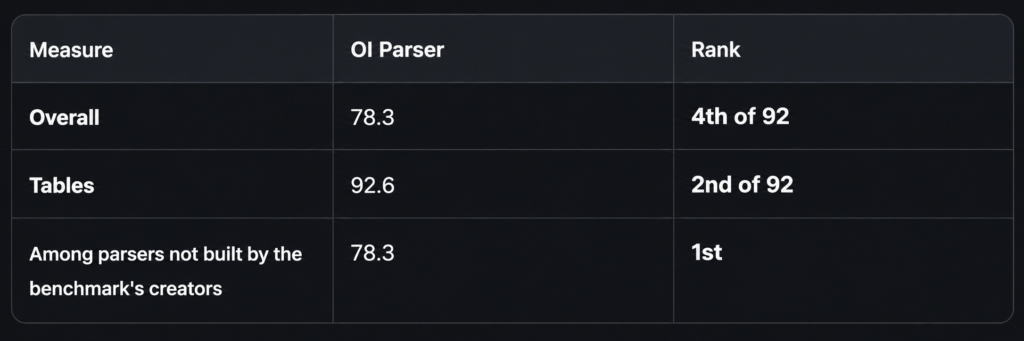
The only three methods above OI Parser overall are the three tiers of LlamaParse, built by LlamaIndex, the company that created and operates the benchmark. Any team has a tuning advantage on a benchmark they designed. Setting those three aside, OI Parser is the top-ranked document parser on the public leaderboard.
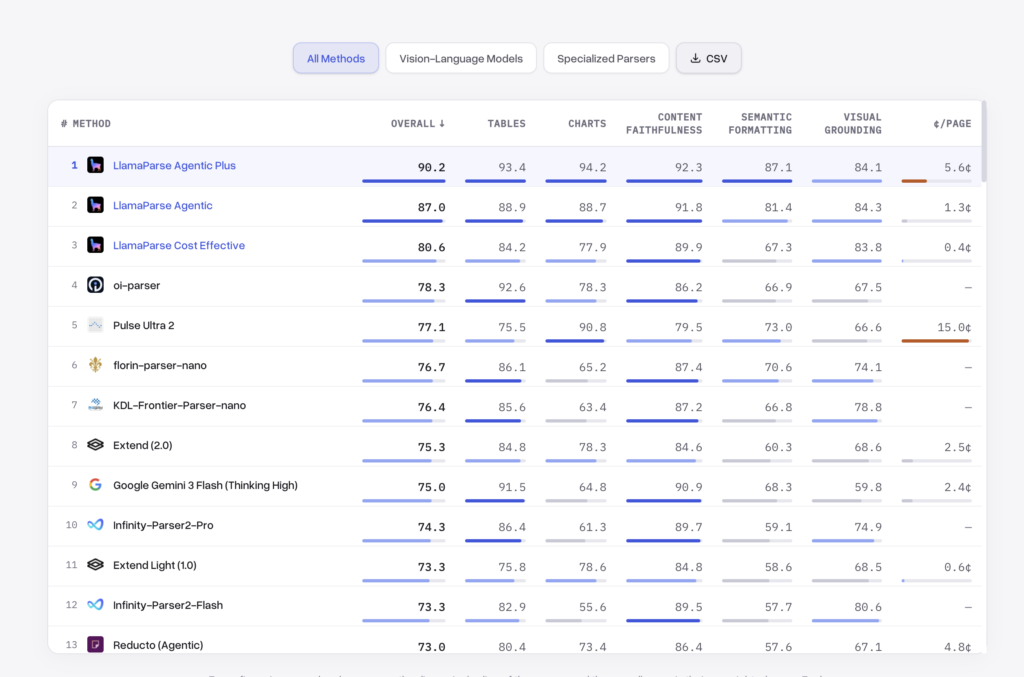
Scores Across All Five Dimensions
The honest picture, with the best score on the whole leaderboard alongside each of ours:
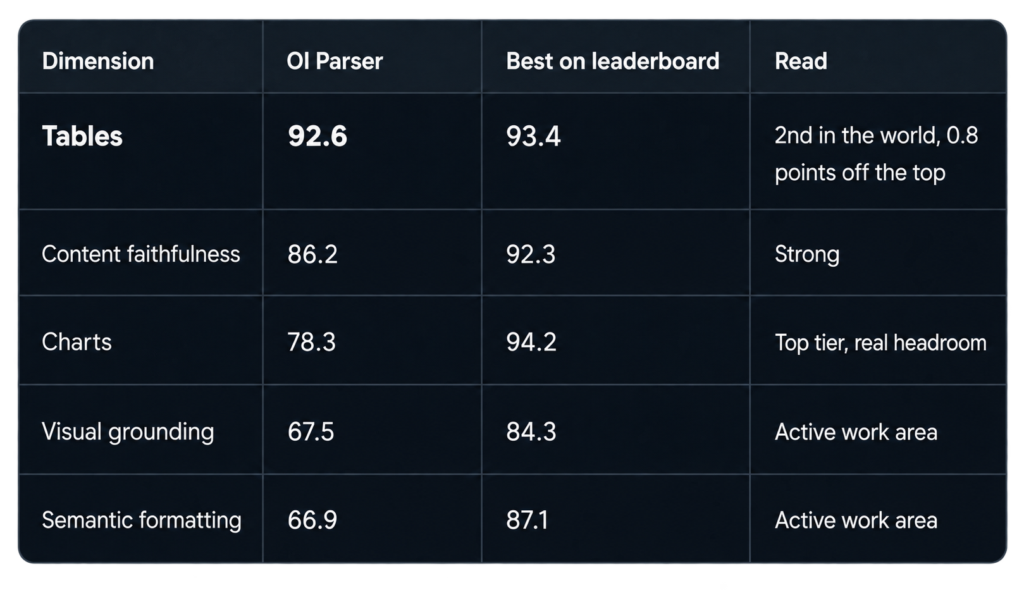
Tables are the result we are proudest of. Tables are where enterprise value concentrates: line items, balances, rates, terms. A parser that gets tables wrong feeds agents wrong numbers. Second in the world, 0.8 points behind the top score on a 92-method board, is a genuinely defensible position.
We are publishing the two weaker dimensions alongside the two strong ones deliberately. Semantic formatting and visual grounding are known work areas with identified fixes, and a benchmark post that only shows the winning columns is not worth much to a technical reader.
How OI Parser Works: Pipeline Architecture Over Parameter Count
The most interesting part of the result is not the rank. It is the compute budget.
OI Parser is built on compact, self-hosted models, orders of magnitude smaller than the frontier vision models it outranks. The leverage is not in scale, it is in construction.
The clearest evidence sits on the public leaderboard itself. On the charts dimension, several dedicated OCR models score below 2 points out of 100. These are competent models: they read the text inside a chart perfectly well. What they cannot do is say what the chart means. OI Parser scores 78.3 on the same dimension, and the difference is almost entirely the pipeline wrapped around the model, not the model itself.
The Pipeline
OI Parser’s extraction pipeline does five things that default model paths do not:
Layout-aware routing. Before any content extraction, a layout pass identifies what is on the page: prose blocks, tables, charts, figures, captions, formulas. Each region is routed to a specialist path rather than a one-size-fits-all generator.
Crop and isolate. Charts and tables are cropped from their page context and processed in isolation. This eliminates the distraction tax a full-page model pays when a chart is one of fifteen elements competing for attention.
Prompt specialization per region type. Charts get a charts prompt. Tables get a tables prompt. Each is tuned for the structural conventions of that region type: axis types, legend semantics, header hierarchies, merged cells.
Structured reconstruction. Outputs are reassembled into a faithful structural representation of the source. Cells stay cells, axes stay axes, captions stay attached to figures. Nothing is flattened into a wall of text the way OCR-first paths do.
Cost-aware page routing, biased toward safety. Pages that are provably machine-readable skip the vision model entirely. The router is deliberately asymmetric: an unnecessary vision call is cheap, while silently losing content is expensive, so it pushes the cheap error toward the common case and the expensive error toward zero.
Two more properties matter in production. Every specialized path has a fallback, so extraction always produces output rather than failing a customer’s ingestion run. And every extracted value carries provenance back to its page, region, and bounding box, so any number an agent cites can be verified at the source.
The takeaway for anyone designing a document understanding system: the architecture is doing the work, not the parameter count. Crop, isolate, route, and prompt is a far cheaper lever than scaling to a frontier-sized model and hoping.
This is also why OI Parser is practical to deploy in air-gapped and on-premises environments. The compute footprint is reachable for sovereign deployments in a way frontier proprietary models are not.
Beyond PDFs: Excel, Word, PowerPoint, and Scans
ParseBench benchmarks PDFs. But PDFs are a fraction of any real enterprise document estate.
The same pipeline investment, layout routing, region isolation, prompt specialization, and structured reconstruction, went into the other format paths. Each format is parsed natively, then normalized into the same clean schema, so downstream systems see one contract regardless of what came in.
XLSX: multi-sheet workbooks, merged-region handling, named-range awareness, formula results resolved to real values, embedded chart extraction, and per-cell number formats applied so a percentage arrives as a percentage.
DOCX: heading hierarchy, styled lists, inline tables, footnotes and endnotes, embedded images with captions, headers and footers.
PPTX: slide reading order, title hierarchy, speaker notes, tables and charts, embedded media, and slide-to-slide narrative reconstruction.
Images and scans: skew and rotation correction, low-contrast recognition, photographed pages, table detection, reading order, and language detection.
For teams indexing real document estates, having one service that handles every format to the same quality bar is a meaningful operational simplification.
Where OI Parser Fits in an AI Stack
A few patterns we recommend, based on how OI Parser is used inside Agent Fabric.
Retrieval and Knowledge Base Ingestion
This is the highest-leverage use case. The quality of your retrieval is bounded by the quality of your extraction. If tables, charts, and figures are flattened into noise during ingestion, no amount of retriever tuning recovers what was lost.
For knowledge base ingestion, run OI Parser in its layout and vision mode. It is slower than OCR-only paths, but you move from OCR-tier extraction to top-of-leaderboard extraction on tables, charts, and structure. That difference compounds across every retrieval downstream.
Chat-Shaped and Lighter Agentic Workloads
For chat applications, quick question answering, and lighter agent loops where latency matters more than maximum fidelity, run OI Parser in OCR mode. Faster, lighter on GPU, and a good fit for chat-shaped traffic.
Document-Centric Agentic Workflows
For agents that operate on documents, financial review, compliance checks, technical document analysis, the layout-aware structured output is what makes downstream reasoning tractable. Agents cannot reason cleanly over flattened text. They can reason over a structured representation that preserves the actual document, and because tables arrive as typed rows and columns, an agent can calculate over a parsed financial model rather than guessing at prose.
Compliance, Audit, and Regulatory Review
For workflows where extraction errors carry real downstream cost, regulatory submissions, audit evidence, lab results, table and chart fidelity is the part that matters most. Provenance is what closes the loop: because every value links back to its page and region, a reviewer can verify any number against the source page instead of taking the pipeline’s word for it.
Sovereign by Design
OI Parser inherits the deployment posture of Agent Fabric: sovereign by design, on-premises, air-gapped, no data egress.
For customers in regulated industries and government, this is non-negotiable. Frontier proprietary models can be excellent in absolute terms, but they require sending data outside the customer’s control boundary. OI Parser runs entirely inside the customer’s deployment, on hardware the customer controls, with no telemetry leaving the perimeter, and every extraction isolated per tenant.
Set that against the leaderboard’s cost column. The frontier models that trail OI Parser charge between 2 and 16 cents per page through external APIs. That means shipping your contracts and filings out of your boundary, and paying per page, forever. OI Parser delivers higher benchmark quality from inside your own environment.
This is the core reason OI Parser exists at the compute budget it does. A compact self-hosted stack is something a regulated customer can actually deploy and operate. A frontier proprietary model is something they can rent, on the vendor’s terms, under the vendor’s data policies.
For MENA enterprises and government entities operating under data localization mandates, that distinction is the entire conversation.
What’s Next
OI Parser is one building block of Agent Fabric. There are more coming, and we will share each one as it lands.
The immediate roadmap for OI Parser itself is set by the two dimensions where the leaderboard says we have the most headroom: semantic formatting and visual grounding. Both have identified fixes in flight.
In the meantime:
Try it on your own files: oi-parser.ai
Public leaderboard: parsebench.ai
Benchmark dataset: huggingface.co/datasets/llamaindex/ParseBench
Methodology paper: arXiv:2604.08538
Talk to Us
OI Parser is available today as part of Agent Fabric, and as a standalone document extraction service for teams that want best-in-class extraction without adopting the full platform. Deployment options include hosted API, on-premises, and air-gapped.
If you are building retrieval pipelines, agentic workflows, or document-heavy AI systems, and the quality of your extraction is the ceiling on what you can ship, we should talk.

Muhammad Ahmad Afzal
Senior Product Manager