Building your first AI agent has never been easier. A small team wires a model to a few APIs, tests it on clean data, and watches it complete a workflow on its own. The demo lands. Then reality arrives.
The numbers are sobering. A March 2026 survey of 650 enterprise technology leaders found that 78 percent have at least one AI agent pilot running, but only 14 percent have successfully scaled an agent to organization-wide operational use. The gap between those two numbers is the defining business challenge of the year, and it has almost nothing to do with the quality of the models.
The companies stuck in permanent proof-of-concept mode are not failing because the model is not smart enough. They are failing because they treated agent deployment as a software launch when it is actually a lifecycle. The first agent is easy. The second year is where enterprises break.
The chasm is real, and it has a location
The failure is not evenly spread across the journey. It has a specific address. One 2026 maturity model found that 78 percent of companies reach the prototype stage of fewer than five agents, but the moment they try to scale to between five and twenty agents, sixty percent get trapped in what the report calls the Stall Zone. Only 31 percent reach stable production.

The research on why is consistent. One analysis found that five gaps account for 89 percent of scaling failures: integration complexity, inconsistent output quality at volume, absence of monitoring tooling, unclear organizational ownership, and insufficient domain data. And these are not independent problems. Ownership gaps leave monitoring gaps unfilled, which makes quality problems invisible until they compound into an incident. Three forces do most of the breaking.
The three ceilings that break agents after launch
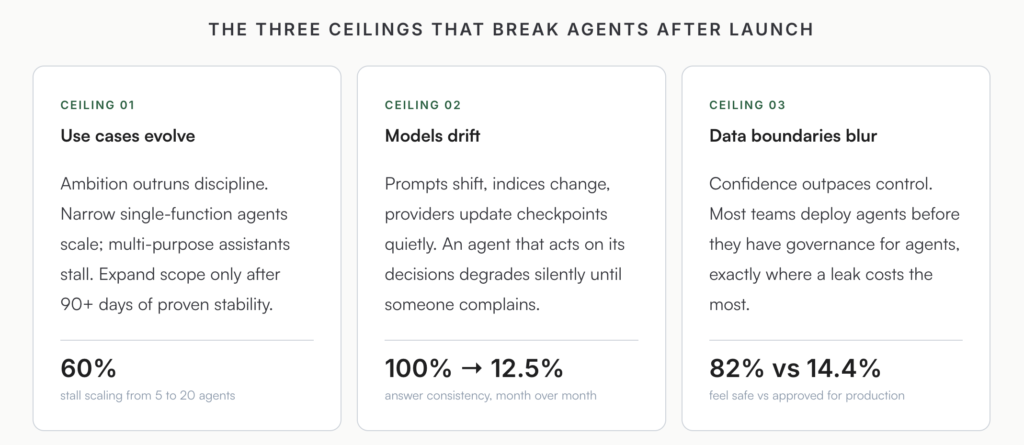
Ceiling one: use cases evolve faster than your discipline
The first agent works because it is narrow. Clean data, tight scope, a single well-defined task. Success creates pressure to expand, and expansion is where most programs lose control.
The counterintuitive lesson from the field is that ambition is the enemy of reliability. Narrow, single-function agents scale far more reliably than broad, multi-function ones. The organizations that make it start with an agent scoped to one clearly defined task and only expand scope after the narrow version has proven stable for ninety days or more. The ones that fail typically try to build a multi-purpose assistant before they have learned what production reliability even looks like for a single task.
There is a simple design question underneath all of this. It is not how many things an agent can do. It is what is the smallest scope that delivers the outcome reliably. Every additional capability is additional surface area for failure, additional cost, and additional governance burden.
Ceiling two: models drift, silently
This is the ceiling most roadmaps ignore, and it is the one that turns a trusted agent into a liability without anyone noticing. A model that passes every pre-production evaluation can still degrade silently once it is live. Prompts shift, data distributions evolve, retrieval indices change, and model providers quietly update the underlying checkpoints behind their APIs. None of these events announces itself. The agent keeps running. The outputs just get worse.
The concrete version should alarm anyone in a regulated sector. A production system that answered the same regulatory question with one hundred percent consistency last month can drop to 12.5 percent consistency this month, with nobody flagging it. And drift in an agent is not a cosmetic issue, because these systems execute actions rather than merely answer questions. A drifting agent is making progressively worse decisions inside your operations, and acting on them.
Detecting behavioral drift, semantic drift, and degradation in decision quality requires monitoring built for agents specifically, running continuously against live traffic. If your only signal that something is wrong is a customer complaint, you have already been operating a degraded agent for weeks.
Ceiling three: data boundaries blur and leakage happens
The third ceiling is the widening gap between how safe leaders believe their agents are and how safe they actually are. In one 2026 security survey, 82 percent of executives said they were confident their policies protect against unauthorized agent actions. Yet only 14.4 percent of organizations send agents to production with full security or IT approval. Most companies are deploying agents before they have governance for those agents.
This is where the stakes diverge sharply by industry. The same model error that earns a bad review in consumer tech can cost a regulated institution millions. For a bank, a hospital, or a government entity, the real question stops being can the AI answer and becomes can the institution prove the AI answered within policy, used approved data, escalated correctly, and logged the decision path.
Regulators have noticed. In June 2026, a Bank of England deputy governor warned that agentic AI may require regulatory reform, because existing oversight was never designed for autonomous agents operating in sensitive areas. “The model decided” is no longer an acceptable answer, and an agent partner who cannot show a clear, queryable trace of every decision is not ready for a regulated environment, however polished the demo.
The lifecycle is the product
Put the three ceilings together and a single conclusion emerges. Scaling agents is not a bigger deployment. It is a different discipline, and the organizations that win treat that discipline as the actual product.
The evidence backs this precisely. Organizations that invest early in unified governance put more than an order of magnitude more AI projects into production than those without it. Teams using systematic evaluation frameworks achieve nearly six times higher production success rates. The differentiator was never the model or the prompt. It was evaluation infrastructure, monitoring, clear ownership, and a dedicated operations function, built before scaling rather than retrofitted during it.
The bottom line
Shipping the first agent proves the technology works. Running fifty agents for two years without a compliance incident, a silent regression, or a data leak proves the organization works. The pilot is a moment. The lifecycle is the product, and it is where enterprise AI is won or lost.
Agent Fabric is built for the second year, not just the first demo. Continuous evaluation, drift detection, human-in-the-loop checkpoints, identity-aware data access, and a fully queryable audit trail are part of the platform, so the discipline that survives scale is designed in from the start rather than bolted on after the first incident.
Sources and further reading
Zen van Riel, “Why 78% of AI Agent Pilots Never Reach Production”
Digital Applied, “AI Agent Scaling Gap March 2026: Pilot to Production”
AgentMarketCap, “The Enterprise Agent Deployment Maturity Model 2026”
Pebblous, “Six Data Defects That Stall Enterprise AI Agents” (citing RAND)
Galileo, “9 Best LLM Drift Monitoring Platforms in 2026”
ValueStream AI, “AI Monitoring in Production 2026”
AI Assembly Lines, “Why Do Enterprise AI Agents Fail in Production?”
Jinba, “Why AI Pilots Fail in Banking and Insurance: The 2026 Production Gap Report”

Muhammad Ahmad Afzal
Senior Product Manager