For three years, prompt engineering was the most-hyped skill in technology. Job titles were created for it. Courses were sold on it. And then, quietly, the industry moved on.
The conversations that serious engineering teams have in 2026 are no longer about whether to use chain-of-thought or how to phrase an instruction. They are about context budgets, retrieval precision, and memory tiers. The interesting questions moved up a layer, and the discipline that now occupies that layer has a name: context engineering.
If your agents are giving irrelevant answers, forgetting what they were told, or quietly getting more expensive every month, the model is probably fine. The problem is almost certainly the context.
From prompt engineering to context engineering
Prompt engineering asked a narrow question: what words should I use? Context engineering asks a much broader one: what configuration of information is most likely to produce the behavior I want?
The distinction matters because agents fail differently than chatbots. A chatbot answers one turn at a time, so a clever prompt can carry it. An agent runs in a loop across many turns, accumulating state, calling tools, and making dependent decisions where an early mistake compounds into later failure. Its failure modes are state-management failures, not phrasing failures.
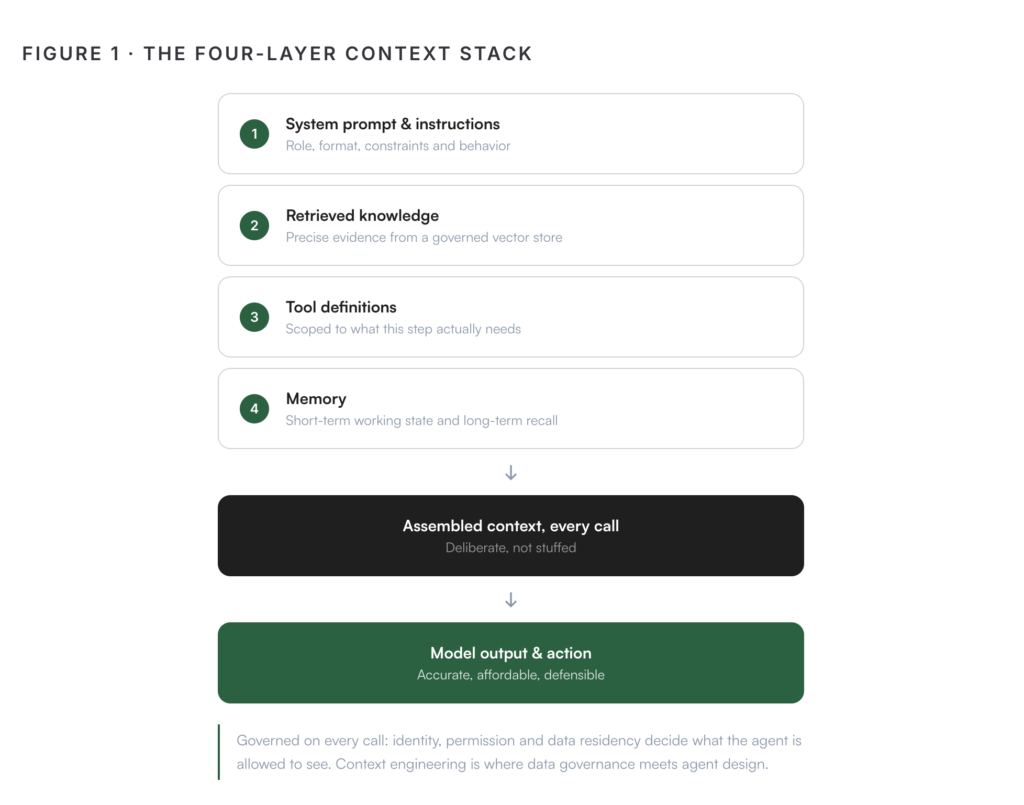
Context engineering is the deliberate design of everything a model sees on every inference call: the system prompt, the user input, retrieved documents, conversation history, tool definitions, and long-term memory. It treats the model’s input not as a single static prompt but as a dynamic, multi-layered system that changes based on the task, the user, and the environment.
The problem of context rot
The most counterintuitive finding of the last two years is that more context often makes agents worse.
Even frontier models with million-token windows produce measurably worse outputs when you fill the window with marginally relevant content. The industry learned this the hard way. The instinct in 2024 was to stuff everything into the context window because you could. By 2026, the discipline had shifted to engineering what enters it, precisely because filling the window degrades quality.
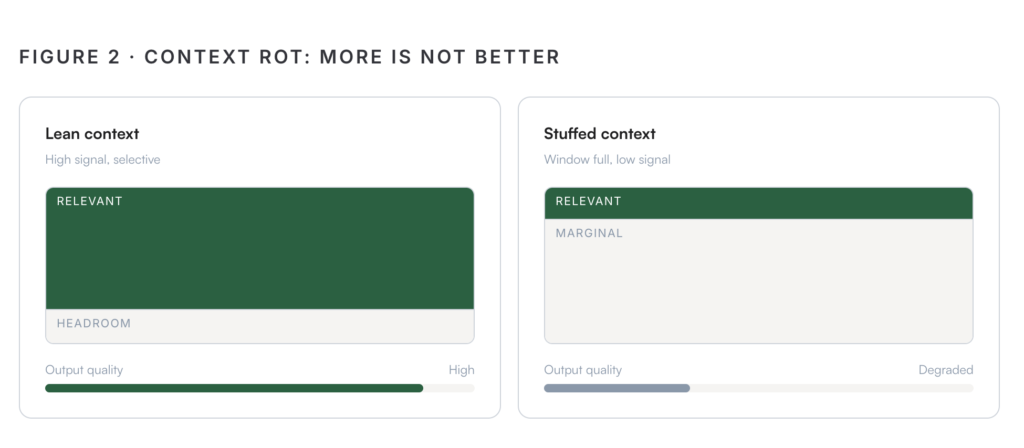
This phenomenon has a name too: context rot. A model asked to reason over a window packed with loosely related material has to work harder to find the signal, and its accuracy drops. The best teams treat context as a scarce resource to be spent deliberately, not a bucket to be filled.
The economics nobody talks about
Context engineering is not only a quality discipline. It is a cost discipline, and at scale the numbers are brutal.
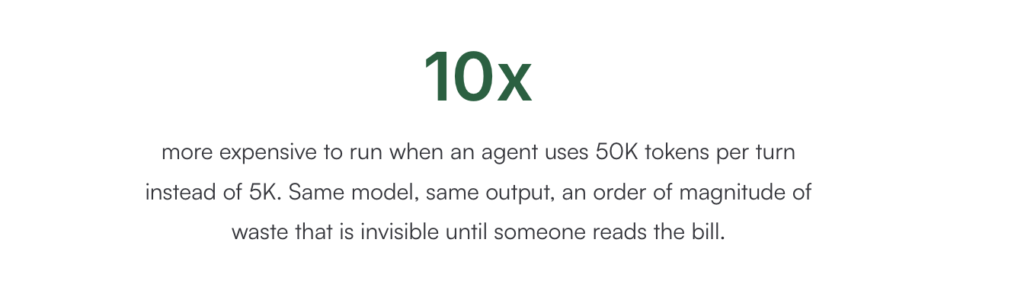
A poorly contexted agent that burns fifty thousand tokens per turn when it should use five thousand is ten times more expensive than the well-engineered version. At the volume of a real production deployment, that is the difference between a viable product and a money pit. Two teams can ship functionally identical agents on the same model, and one can be an order of magnitude more expensive to operate purely because of how it manages context.
Why context engineering is really a governance problem
Here is the part most technical treatments miss, and the part that matters most in a regulated enterprise. The core question of context engineering is: what is this agent allowed to see on this call? In a consumer chatbot, that is a quality and cost question. In a bank, a hospital, a ministry, or any organization operating under a data protection law, it is a compliance question.
Every document you retrieve into an agent’s context is a data access event. Every field you surface is a decision about who is permitted to see what. Least privilege, purpose limitation, and data residency are not abstract principles here; they are properties of the context you assemble on every single inference call. Context engineering is where data governance meets agent design, whether or not the team building the agent realizes it.
For organizations subject to frameworks like the UAE’s Personal Data Protection Law, this reframes context engineering from an optimization technique into a control surface. The same discipline that keeps your agents accurate and affordable is the discipline that keeps them compliant. When you engineer context well, you are deciding, provably and per call, what data the agent touched and why. That is exactly the record an auditor will one day ask for.
Practical principles for enterprise teams
Start lean and add only what earns its place. Default to the minimum viable context and expand deliberately, rather than dumping everything in and hoping the model sorts it out.
Retrieve for precision, not recall. The goal of your retrieval layer is not to surface everything that might be relevant. It is to surface the small set that actually is, because everything beyond that is context rot waiting to happen.
Scope tools to the task. Tool definitions consume context and invite confusion. Expose the capabilities the current step needs and hide the rest. Instrument context as a governed asset: log what entered the window on each call, tie it to identity and permission, and make it queryable. And build memory in tiers, because everything you persist is something you will later have to govern.
The bottom line
Prompt engineering treated the model’s input as a sentence to perfect. Context engineering treats it as a system to design, and that shift is most of what defines serious AI work in 2026. For enterprises, it is the point where performance, cost, and compliance converge into a single discipline.
Agent Fabric is built around this principle: context engineering is embedded into the platform rather than left to each team to reinvent. Retrieval runs against a governed platform vector store, context assembly respects identity and permission on every call, and what an agent sees is recorded as part of a queryable audit trail.
Sources and further reading
Jobs by Culture, “Context Engineering Guide 2026: The Discipline That Replaced Prompt Engineering”
Mem0, “Context Engineering AI: How To Build Smarter LLM Agents in 2026”
Taskade, “Context Engineering: Complete 2026 Field Guide for AI”
IntuitionLabs, “What Is Context Engineering? A Guide for AI and LLMs”

Muhammad Ahmad Afzal
Senior Product Manager