TL;DR: An air-gapped AI system is an AI environment that operates without access to external or public networks, keeping sensitive data, models, and infrastructure within a controlled security boundary. In these environments, AI workloads must run using locally available models, container images, GPU software, dependencies, and deployment artifacts. Open Innovation AI’s Engine Fabric enables organizations to manage AI workloads, models, data, experimentation, inference, and GPU resources within fully isolated environments, running on top of a Kubernetes-based infrastructure such as Runtime Fabric.
Modern AI systems are usually designed with the assumption of continuous connectivity to cloud services, external package repositories, and remote APIs. However, in highly secure environments such as government, defense, and critical infrastructure, these assumptions no longer hold. Instead, these systems must operate in complete isolation known as air-gapped environments.
Running AI workloads in these conditions brings unique architectural and operational challenges.
This article explains how air-gapped AI systems work, the challenges involved in operating AI infrastructure without external connectivity, and how Open Innovation AI’s Engine Fabric supports AI operations in fully isolated environments.
What Is an Air-Gapped System?
An air-gapped system is a computing environment that is completely isolated from all external networks. This means there is no direct or indirect data exchange between the air-gapped environment and external networks. Air-gapped architectures are typically implemented in high-security domains where confidentiality, integrity, and operational control are critical requirements.
In practice, air-gapped environments are implemented in different configurations depending on security requirements and operational constraints. The two most common models are fully isolated systems and partially isolated systems with restricted internal connectivity.
Fully isolated systems operate with zero network connectivity, both external and internal beyond the defined secure boundary. All operations, including software installation, updates, and maintenance, must be performed manually through approved physical media and require on-site access under strict security protocols.
In partially isolated environments, limited connectivity is permitted to a controlled internal corporate network. Access is typically restricted to a predefined subnet or secure domain, allowing constrained operational support while still maintaining isolation from external networks. This model provides a balance between strict security requirements and operational efficiency.
The Challenge: Running Modern AI in Isolation
While this level of isolation provides strong security guarantees, it also introduces a new set of operational and architectural challenges that must be addressed across the entire system of lifecycle.
In traditional environments, systems dynamically retrieve dependencies from external package repositories, container registries, and cloud services, something that is not possible in air-gapped environments. Because of that, deployment artifacts must be prepared in advance, including modern AI workloads, containerized applications, and model packages, which together can easily grow to hundreds of gigabytes in size. The artifacts then need to be transferred to the premises via physical media, which must go through a security check and get approved for usage.
Modern AI systems often run across multiple nodes, including control planes, worker nodes, and GPU nodes. In such distributed environments, consistency becomes critical. Since there is no ability to dynamically fix or update dependencies from external sources, every node must run a fully controlled and identical software stack.
Another important requirement in distributed systems is accurate time synchronization. In air-gapped environments, external Network Time Protocol (NTP) servers cannot be used.
These constraints require a fundamentally different approach to deployment and infrastructure management, which is where platforms like the Engine Fabric are introduced.
Engine Fabric: A Unified Platform for Air-Gapped AI Operations
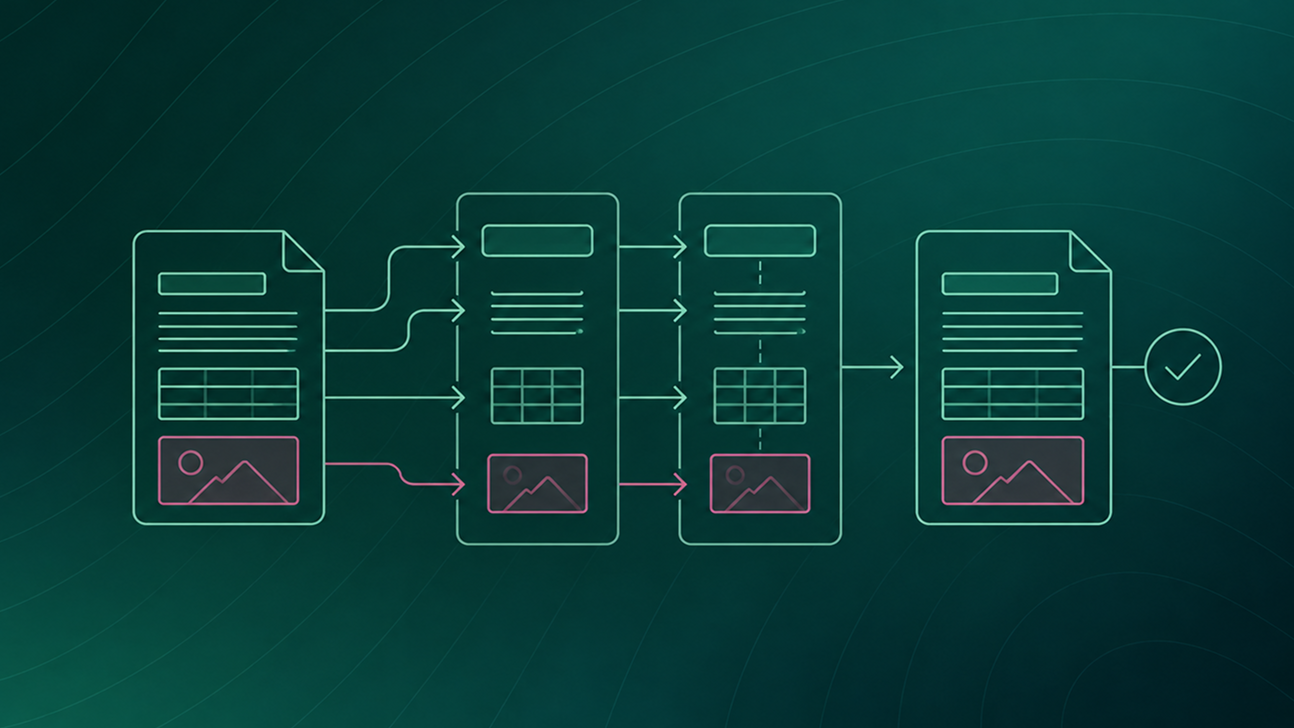
To address these challenges, the Engine Fabric provides a unified framework for deploying, managing, and operating AI workloads in air-gapped infrastructures. Deployment workflows are done completely offline, by relying on pre-packaged and transfer-ready artifacts. This includes containerized application images, Helm-based deployment definitions, and supporting automation scripts. These components are prepared in advance and transferred into the air-gapped environment through approved secure channels. By eliminating any dependency on external repositories or real-time downloads, Engine Fabric ensures that all required software components are available locally before deployment begins.
At its core, Engine Fabric operates on top of Runtime Fabric, Open Innovation AI’s Kubernetes-based infrastructure foundation. Runtime Fabric provides the environment in which workloads run across a cluster of nodes, while Engine Fabric intelligently schedules AI workloads across available compute resources, including high-performance GPU nodes. The platform also enforces clear separation between different execution environments, helping applications, services, and model workloads run in isolated and predictable conditions.
Beyond infrastructure management, Engine Fabric provides a unified interface for interacting with the entire AI lifecycle. Through this interface, users can deploy models, manage data assets, run notebooks for experimentation, and monitor system performance. This abstraction simplifies operational complexity and allows users to focus on AI development and deployment rather than underlying infrastructure constraints.
Operational Reality
Beyond the technical architecture, air-gapped environments introduce a very different operational reality compared to cloud-based systems.
As systems are deployed in highly secure on-premises data centers, all work must be performed directly within the isolated infrastructure. This means engineers and operators are required to be physically present for all of the deployment and maintenance tasks.
In practice, this includes working in restricted server rooms with limited access, strict security procedures, and carefully controlled operational conditions. External tools, internet access, and communication devices are restricted, which places additional emphasis on preparation and coordination before on-site work begins.
Despite these constraints, well-designed platforms such as Engine Fabric aim to reduce operational friction by standardizing deployment workflows and minimizing the need for manual system-level intervention.
System Architecture Overview
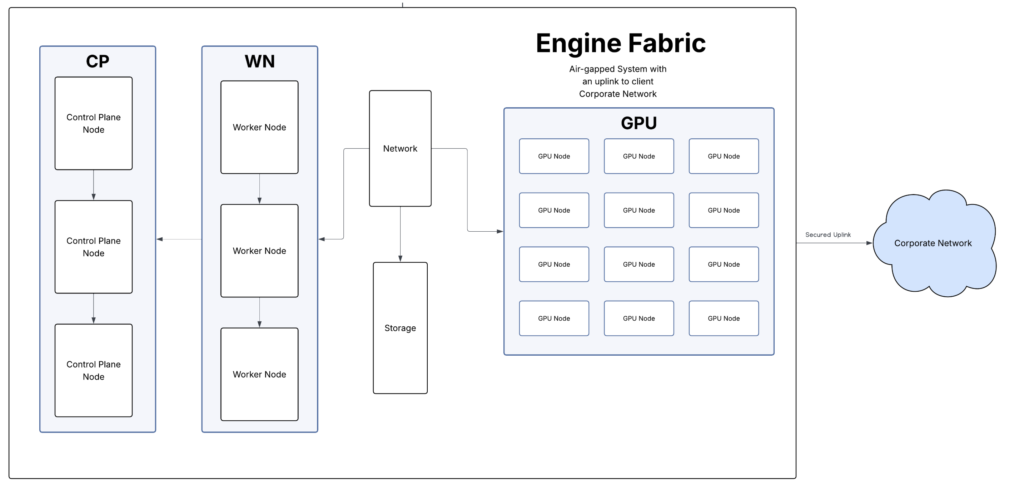
Air-gapped System with an uplink to client Corporate Network
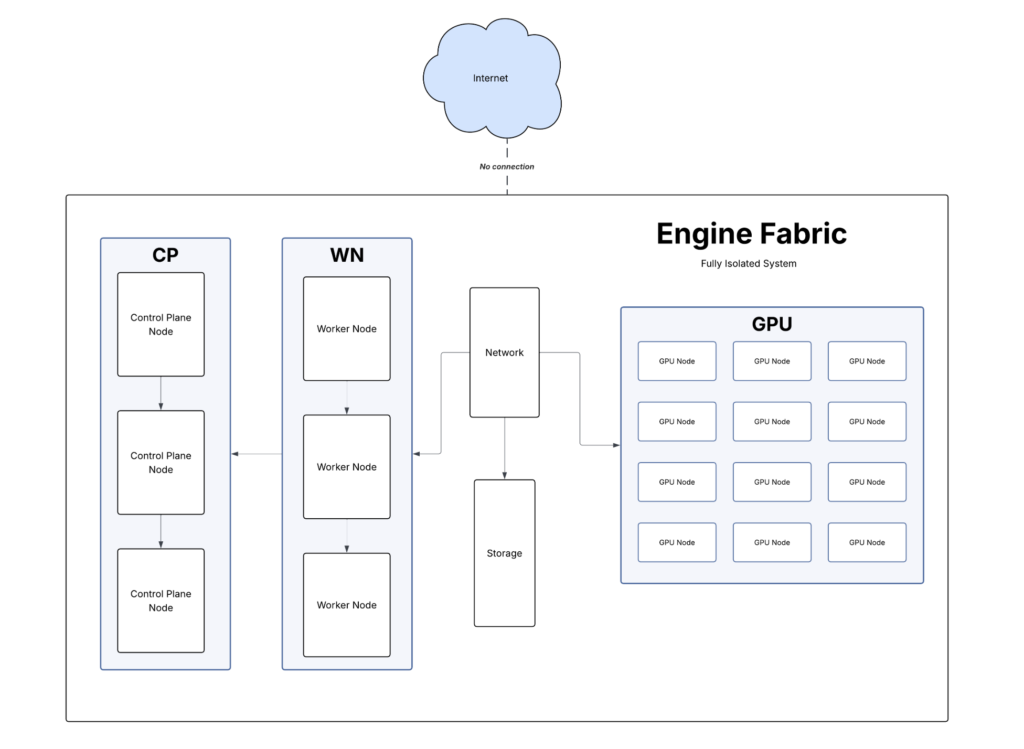
Fully Isolated System
The system is composed of several core components, each responsible for a specific part of the overall functionality. To better understand how Engine Fabric operates, it is useful to look at these components of the underlying infrastructure:
The Control Plane acts as the orchestration layer of the system. It manages the Kubernetes cluster, schedules workloads, and ensures that all components are running as expected.
Worker Nodes are responsible for running application-level workloads, including frontend services, backend APIs, and supporting system components.
GPU Nodes provide high-performance compute resources required for AI workloads such as model training and inference.
The Storage Layer is responsible for managing persistent data, including datasets, model artifacts, and user-generated content.
The Networking Layer enables communication between all components within the system, ensuring that services, nodes, and workloads can interact reliably within the isolated environment.
Together, these components form a cohesive system that enables reliable AI operations within fully isolated environments.
conclusion
Air-gapped AI systems represent a critical evolution of modern infrastructure for environments where security, sovereignty, and operational control are critical requirements.
While challenges in deployment, dependency management, and system coordination do exist, they also drive the need for more structured and reliable infrastructure design.
Engine Fabric bridges this gap by enabling modern AI workloads to run in fully isolated environments without compromising scalability or operational efficiency. By combining pre-packaged deployments, Kubernetes-based orchestration, and a unified operational interface, Engine Fabric brings cloud-native AI capabilities into environments where traditional cloud assumptions no longer apply.
As demand for sovereign AI continues to grow, the ability to operate complex AI systems in isolated infrastructures will become an essential capability across government and enterprise domains.

Katarina Stojiljković
Senior Software Engineer