You Cannot Scale What You Cannot Measure: Why Evals Are The New Unit Tests For AI Agents
September 24, 2026
5 Minutes Read
Every team can build an agent that works in a demo. The ones that keep working in production share one habit: they measure relentlessly.
Gartner projects that by 2028, 40 percent of enterprise AI failures will trace to inadequate evaluation and monitoring of agent systems rather than to gaps in model capability. Read that carefully. The models are not the thing that breaks most often. The blind spot is. Teams pour their attention into the demo and almost none into the instrumentation that would tell them when the demo has quietly stopped working.
In traditional software, no serious team ships without tests. Agents deserve the same discipline, and the practice has a name that is becoming standard in 2026: evals. If you cannot measure whether an agent is doing its job, you cannot scale it, because scaling multiplies both the value and the failure modes.
Why agent evals are different from model evals
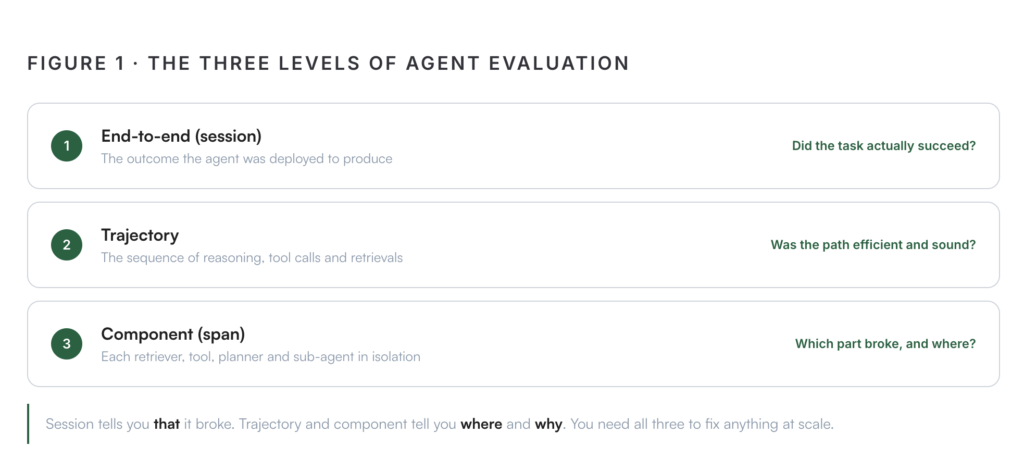
Evaluating a model asks a narrow question: given this input, is the output good? Evaluating an agent asks something harder, because an agent does not produce one answer. It runs a loop, calls tools, retrieves documents, and takes a sequence of dependent steps toward a goal. A right answer reached through a broken path is luck, not reliability, and luck does not survive scale.
That is why the field has converged on evaluating agents at three distinct levels, not one. Each answers a different question, and each catches failures the others miss.
Score the path, not just the answer. A correct output from a broken trajectory will not stay correct.
Deterministic checks and LLM-as-a-judge
Once you know what to measure, the question is how to score it. There are two tools, and mature teams use both deliberately rather than reaching for the fashionable one.
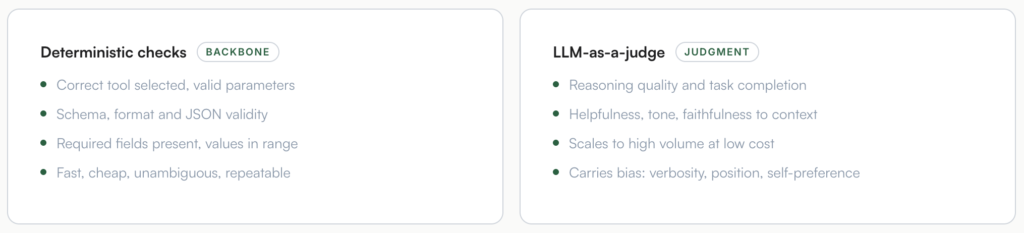
Deterministic checks are the backbone. Exact tool names, required parameters, valid JSON, expected outputs, and format rules do not need a language model to grade them; a rule does the job faster, cheaper, and without ambiguity. LLM-as-a-judge handles what rules cannot: reasoning quality, task completion, helpfulness, tone, and other criteria that require judgment over context and intent.
Use deterministic checks for exact things and a calibrated judge for the subjective ones. Never one alone.
The honest caveat matters here, because LLM-as-a-judge is easy to trust too much. Judges show documented biases toward verbose and first-listed answers, and they can reward a fluent rationale for an unsound decision. Worst of all is the common anti-pattern of using the same model to produce and to grade its own work, which builds in blind spots, because a model tends to rate its own failure modes as acceptable. The fixes are well established: calibrate the judge against a human-labeled sample before trusting it at scale, use structured rubrics with binary or few-level criteria rather than open one-to-ten scores, judge the whole trajectory rather than the final answer alone, and keep a different model in the judge seat than the one under test. Detailed rubrics push judge agreement with human reviewers above 0.85 correlation, but that number is earned through calibration, not assumed. The frontier is already moving toward tool-augmented Agent-as-a-Judge evaluators, but the discipline underneath stays the same.
Evals are a heartbeat, not a launch gate
The most common mistake is treating evaluation as a one-time gate before go-live. Agents degrade silently in production as prompts shift, data changes, and providers update the models behind their APIs. An eval suite that ran once at launch tells you nothing about the agent you are running today.
The practice that works is continuous. Run regression suites on every change so a prompt tweak cannot silently break a workflow. Sample a slice of live traffic, commonly five to ten percent, for ongoing LLM-as-a-judge scoring. Set threshold-based alerts that fire when quality drifts below a line you defined in advance. Evaluation stops being a document and becomes a monitor.
Evaluation is where reliability is proven, and where most programs are under-invested.
Why regulated teams need evals before the second agent
In a regulated enterprise, an eval suite is not just an engineering nicety. It is evidence. It is how you demonstrate that an agent behaves within policy, how you catch a silent regression before an auditor or a customer does, and how you show, on demand, that the system you deployed still does what you certified it would do.
Paired with a queryable audit trail, evaluation becomes the backbone of defensibility. The audit trail records what the agent did; the eval suite proves it was supposed to. Teams that build this infrastructure before they scale put far more agents into production than those who bolt it on afterward, because they can trust each new deployment instead of hoping it holds.
The bottom line
Shipping an agent is a demo. Knowing, continuously and provably, that it still works is a product. Evaluation at three levels, deterministic checks with a calibrated judge, and continuous monitoring in production are what turn an impressive prototype into a system an enterprise can scale and defend.
At AgentFabric, evaluation is treated as a first-class part of the platform: trajectory-aware scoring, regression suites tied to every change, and continuous production sampling feed the same queryable record that makes an agent auditable. The discipline that lets you trust the first agent is the discipline that lets you scale to the fiftieth.
An AI agent can pass every test, behave normally for months, and still carry hidden malicious behavior waiting for the right trigger. Here’s why securing agentic AI requires protection before and after deployment.
A technical look inside OI Parser, the document extraction layer underneath our agentic platform, and how it preserves structure across PDFs, spreadsheets, presentations, scans, and other enterprise documents to produce data AI systems can reliably use.